
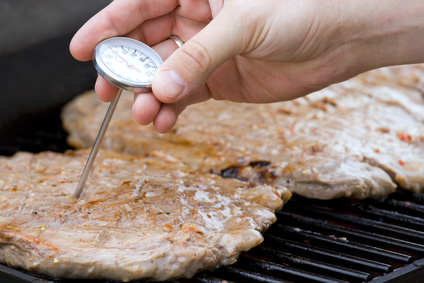
Insufficient heating of food is currently one of the most frequently neglected issues identified during inspections in gastronomy and collective catering. Poultry is particularly critical, as it carries a high risk of pathogenic microorganisms such as Salmonella and Campylobacter.
Legal and Professional Requirements (CH & DE)
Both in Switzerland (HyV, Food Hygiene Ordinance) and in Germany (LMHV, EU Regulation 852/2004), it is clearly stipulated that:
Food must be heated in such a way that health risks are reliably eliminated or reduced to a minimum.
For poultry, the following professional standard is well established:
- At least +70 °C core temperature for ≥ 2 minutes (e.g. according to the approved GVG guideline)
or
- an equivalent time–temperature combination
In the Alcomo HACCP App, a holding time of 3 minutes is specified to ensure a reliable reduction of relevant pathogenic microorganisms, including in other animal-based foods.
In most operations, this heating step is classified as a Critical Control Point (CCP) because:
- no subsequent process step can compensate for insufficient heating
- there is a direct health risk to guests
Typical Practical Issues
Audits and official inspections repeatedly reveal the same weaknesses:
- core temperatures are not measured at all or only sporadically
- measurements are taken at the surface rather than in the core (probe measurement)
- values are not documented or are not traceable
- no defined corrective action exists if the target temperature is not reached
Why Continuous Monitoring Is Essential
Especially for poultry, a single check is often insufficient due to:
- varying portion sizes
- different equipment, programs and settings
- high time pressure in daily kitchen operations
Structured, regular measurement and documentation of core temperatures are therefore essential – not only to ensure food safety, but also to provide protection during inspections, complaints and liability cases.
Conclusion
Correct heating of poultry is not optional – it is mandatory.
As a clearly defined CCP, it must be systematically monitored, documented and immediately corrected in case of deviations – ideally in a digital, simple and practical way, for example using the Alcomo HACCP App, which supports structured recording, traceability and evaluation of core temperatures in everyday kitchen operations.
Nice to know: Why Core Temperature Is So Important
The term pasteurization, named after Louis Pasteur, describes a process in which food is heated in a controlled manner to reduce harmful microorganisms (e.g. Salmonella, Listeria) to a safe level without sterilizing the product.
This principle also plays a key role in cooking meat: what matters is not only the surface temperature, but above all that the core of the food reaches a sufficiently high temperature for a defined period of time.
Why must the core be heated?
- In poultry, minced meat or mechanically processed meat, microorganisms may be distributed throughout the entire product. Therefore, heat must penetrate all the way to the core.
- An exception applies to whole muscle cuts of beef, such as steaks or roasts. In these cases, microorganisms are mainly present on the surface and are eliminated by searing on all sides.
- Microbial reduction follows a time–temperature relationship: higher temperatures act quickly, lower temperatures require longer holding times.
Time and Temperature – a Combined Effect
Food microbiology shows that:
- the higher the core temperature, the shorter the required holding time
- poultry is subject to particularly strict requirements, which is why a core temperature of ≥ 70 °C is generally recommended in practice
- low-temperature processes (e.g. sous-vide) require precisely controlled conditions and are only safe within clearly defined parameters
Important:
These principles are intended to support understanding of food safety. In everyday kitchen practice and within HACCP systems, clear and safe target values must be defined and strictly adhered to, especially for poultry.
In short:
Not “overcooking at all costs”, but controlled heating – the core temperature determines safety.